
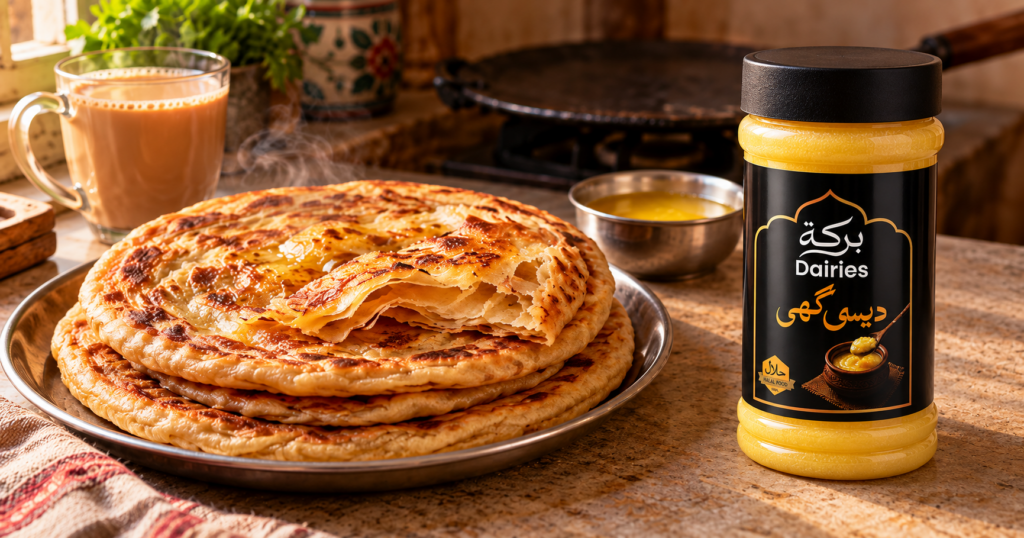
A crispy desi ghee paratha comes down to three things: a soft, rested dough, a thin spread of ghee between every fold, and a tawa that is properly hot. Get those right and you get golden, flaky layers outside with a tender centre.
Ingredients for Desi Ghee Paratha (Makes 4)
- 2 cups atta (about 250 g)
- ½ teaspoon salt
- 1 tablespoon desi ghee, for the dough
- About ¾ cup lukewarm water, added gradually
- 3 to 4 tablespoons desi ghee, for layering and cooking
- A little dry flour for rolling
How to Make Crispy Desi Ghee Paratha, Step by Step
1. Knead a soft dough and let it rest
Rub the tablespoon of ghee into the atta and salt, then add water gradually. The dough should be soft and pliable, softer than everyday roti dough. Knead for about five minutes, cover, and rest it for 20 to 30 minutes so it rolls out thin without shrinking back.
2. Roll, layer and fold
Divide the dough into four balls and roll one into a thin circle. Spread about a teaspoon of ghee across it, then pleat it like a paper fan, or fold it into a square or triangle. Press it flat and roll it out again, gently. Thin, even layers become crisp, flaky edges. Keep dusting flour light, as too much dries the surface.
3. Cook on a hot tawa
Heat the tawa on medium-high. Lay the paratha down and flip it once the underside sets, roughly 15 seconds. Brush with ghee, flip again, and brush the other side. Two or three flips are plenty. It is ready when golden with deeper brown spots, usually three to four minutes in total.
Why Does My Paratha Turn Hard or Soggy?
Usually one of these is the cause:
- The tawa is not hot enough. A cool pan dries the dough slowly, making it tough instead of crisp.
- Too much flipping. Constant turning dries it out until it turns cracker-hard.
- The dough is stiff or under-rested. It will not roll thin, so layers stay thick and chewy.
- Hot parathas are stacked in a closed box. Trapped steam softens the crust within minutes. Use an open, cloth-lined basket.
Does the Quality of Desi Ghee Matter for Paratha?
It does, for both flavour and how the fat behaves on a hot tawa. Real ghee carries a nutty aroma into every layer, while banaspati or blended ‘ghee’ often tastes flat or greasy. Not sure what is in your jar? Read our guide on how to identify pure desi ghee, or see how it compares in desi ghee vs banaspati.
Barakah Dairies makes its desi ghee in small batches in Sahiwal using the traditional bilona method, and states that it contains no added colour, fragrance or preservatives. It also lists the ghee as suitable for everyday frying.
How Much Ghee Is Sensible?
Ghee is almost entirely fat, and much of it is saturated. The World Health Organization advises keeping saturated fat below 10 percent of daily energy intake. So use ghee for flavour, not as a frying pool: about a teaspoon per layer and a light brush on the tawa is enough. If you have heart disease or diabetes, follow your doctor’s advice on fats. Our article on eating desi ghee daily covers portions.
Paratha FAQs
Can I prepare parathas ahead of time?
Yes. Roll and layer them, separate each with butter paper, and refrigerate for a day or freeze. Cook straight from cold on a hot tawa.
Can I make crispy paratha with less ghee?
Yes. Crispness depends more on thin layers and tawa heat than on the amount of ghee.