
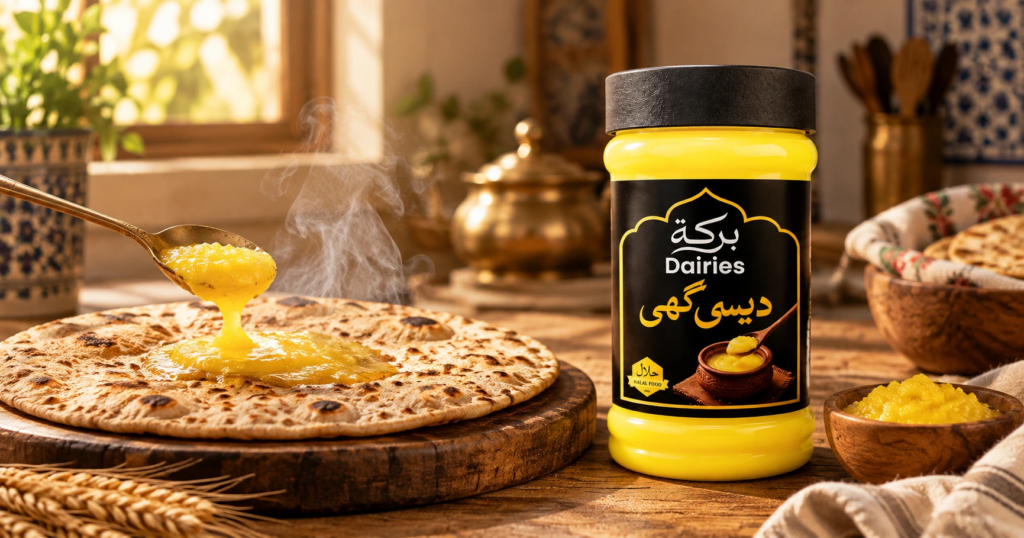
Almost every Pakistani household has an opinion on ghee. Dadi swears by a spoon on daily roti. Some doctors raise an eyebrow at saturated fat. Both are, in a sense, right – and the missing piece in most articles on this topic is that the benefits of daily ghee depend heavily on two things nobody talks about enough: how pure it actually is, and how much you’re eating.
What eating pure desi ghee daily actually does
Ghee made the traditional way – churned from cultured cream and slow-cooked until the milk solids separate – contains short-chain fatty acids, including butyric acid, along with fat-soluble vitamins A, D, E and K. Butyric acid is the same compound gut bacteria produce when they ferment fibre, and it’s known to nourish the cells lining the colon, which is one reason ghee has long been associated with easier digestion in Ayurvedic and desi households alike.
Because vitamins A, D, E and K are fat-soluble, they need dietary fat to be absorbed properly. A spoon of ghee stirred into daal or vegetables can genuinely help your body take up more of those nutrients from the meal, not just from the ghee itself. Ghee also has a high smoke point, so it holds up better under frying and tadka than many refined oils without breaking down into harmful compounds as quickly.
How much desi ghee is safe to eat daily
There’s no single medically “correct” number for ghee specifically, but general dietary fat guidance gives a useful anchor. The World Health Organization recommends that no more than 10% of total daily energy intake should come from saturated fat. For most adults on an average diet, that works out to roughly 1-2 teaspoons of ghee a day when it’s your main added fat, alongside – not stacked on top of – oil used elsewhere in cooking. Children, people managing cholesterol, and anyone with a family history of heart disease should treat that as an upper limit, not a target, and check with a doctor if unsure.
The part most articles skip: is your ghee actually pure?
This is where daily ghee habits in Pakistan can quietly go wrong. Independent testing bodies have repeatedly flagged ghee sold in Pakistan’s open market for being cut with palm oil, vanaspati, or other cheaper fats while still being labelled “pure desi ghee.” If that’s what’s in the jar, the digestion and vitamin-absorption benefits described above simply don’t apply the same way – and hydrogenated fats bring their own health concerns.
A few household checks help: pure ghee should melt almost instantly on warm skin, turn grainy (daanedaar) when refrigerated rather than staying soft, and smell distinctly nutty when heated rather than flat or faintly chemical. None of these replace a lab test, but they catch the most common problems.
This is also why the method matters as much as the marketing. Barakah Dairies makes its ghee using the traditional bilona-style process – milk is cultured, churned into butter, and slow-cooked in small batches until the ghee separates naturally, with nothing blended in afterward. You can read more about how Barakah Dairies makes its ghee if you want to see the process behind the jar before deciding what goes into your family’s daily cooking.
A simple way to think about it
Pure desi ghee, eaten in a modest daily amount, fits comfortably into a Pakistani kitchen – for tadka, for a spoon on daal, for parathas on a weekend morning. The benefits are real, but they’re not unconditional. They depend on genuine purity and a sensible quantity, not on the size of the claim printed on the label.
If you’re switching to desi ghee for the first time, Barakah Dairies’ pure bilona-method ghee is slow-churned from farm-sourced cow’s milk in Sahiwal with no blended oils. For questions about storage, delivery, or ordering, the Barakah Dairies FAQ page covers the practical details.