
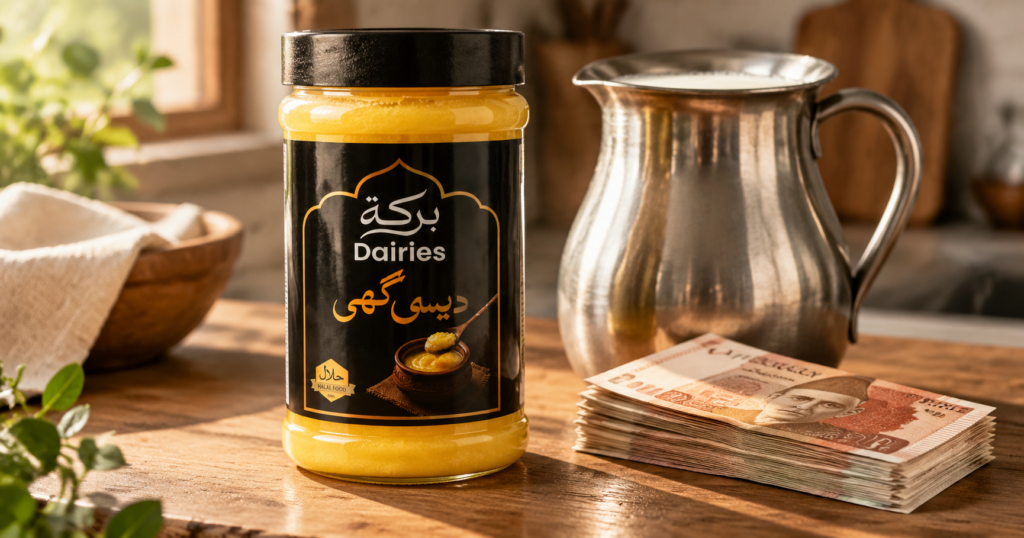
Pure desi ghee costs more than cooking oil, banaspati, or “mixed” ghee for one simple reason: it takes a lot of milk to make very little ghee. Add rising milk prices, slow traditional processing, and the extra cost of staying free from blended oils, and the price gap stops looking unfair. It starts looking like basic math. That’s why pure desi ghee is so expensive in Pakistan.
How Much Milk Actually Goes Into One Jar?
This is the part most price comparisons skip. To produce one kilogram of buffalo ghee, dairies typically need around 12 to 15 litres of milk. Cow ghee needs even more, often 25 to 30 litres, since cow milk carries less fat per litre. When ghee is made the traditional bilona way — culturing cream into curd, churning it into butter, then slow-cooking that butter until only ghee remains — the yield stays low, because nothing but milk fat goes into the pot.
So before a single rupee is added for labour, fuel, or packaging, a 1kg jar of real desi ghee already represents the cost of a dozen or more litres of milk. That is the price floor. Anything sold well below it is worth questioning.
Milk Itself Has Gotten More Expensive
Milk prices across Pakistan have climbed steadily, driven by costlier animal feed, fuel, and general inflation. Packaged milk got noticeably pricier after an 18% tax was added on it in a recent federal budget, a change reported to have pushed retail prices up by roughly a fifth. Loose milk, which most ghee makers rely on, has followed a similar trend. When the raw material costs more, the finished product has nowhere to go but up.
Traditional Ghee-Making Takes Time, Not Shortcuts
Bilona-style ghee is cooked in small batches over low heat, with someone watching the colour, smell, and texture at every stage. That is slower and more labour-intensive than pumping milk fat through an industrial separator. Small-batch production also means less ghee is produced per day, which raises the cost per jar compared to a factory line that never stops.
Why Very Cheap “Desi Ghee” Should Make You Cautious
Adulteration is a recognised issue in South Asian ghee markets. Some cheaper products are stretched with hydrogenated vegetable oils or blended fats, then given an artificial aroma to mimic real ghee. That’s exactly why the price gap exists: a blended product needs far less milk, so it can undercut real desi ghee easily. Pakistan’s government has previously directed the Competition Commission of Pakistan to examine why local ghee prices weren’t tracking cheaper international edible oil rates — a reminder of how disconnected retail pricing can get from actual input costs.
A Practical Way to Judge the Price
Before assuming a jar is overpriced or underpriced, do a rough check yourself: take the local price of a litre of milk, multiply it by roughly 12 for buffalo ghee or 25 for cow ghee, then add a reasonable margin for fuel, labour, and packaging. If a “pure desi ghee” jar costs noticeably less than that number, it is fair to ask what else went into it.
What This Means for Your Kitchen
For families choosing ghee for daily parathas, salan, or a child’s diet, the honest answer is that real desi ghee will rarely be the cheapest option on the shelf — and that is by design, not a flaw. Barakah Dairies makes its ghee from cow’s milk sourced from its own farm in Sahiwal, using the traditional bilona method in small batches, without blended oils or artificial aroma added to bring the cost down. The price reflects the milk that actually goes in.