
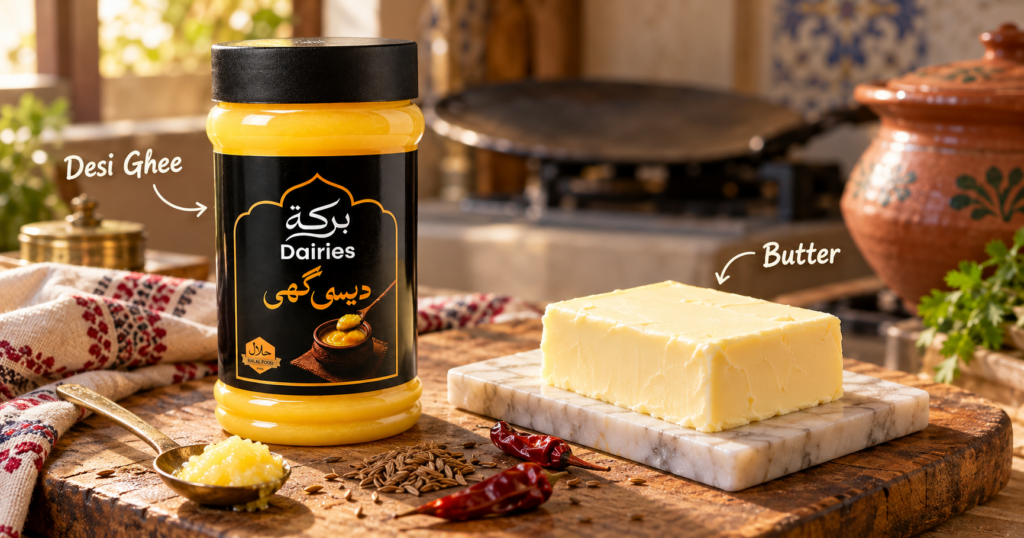
For everyday Pakistani cooking, desi ghee is usually the better choice. It is almost pure milk fat, so it handles the heat of tadka, bhuna and paratha frying without burning, and it keeps well on the shelf. Butter is the better pick for baking, toast and finishing a dish. Nutritionally the two are close: both are saturated fats, so how much you use matters more than which one you pick.
What is the real difference between desi ghee vs butter?
Butter is roughly 80% fat, with the rest made up of water and milk solids. Desi ghee starts as butter (or, in the traditional bilona method, butter churned from cultured cream) and is simmered until the water cooks off and the milk solids separate. What remains is around 99% fat. That one step explains the rest: heat tolerance, shelf life, lactose content and calories per spoon.
Which is better for everyday Pakistani cooking?
Heat decides most of it. Tadka, bhuna masala, tawa parathas and dum biryani all need a fat that stays steady at high temperatures. Butter’s milk solids brown early and burn quickly, and its water makes it spit. Ghee is commonly cited as having a smoke point near 250°C, against roughly 150 to 177°C for butter, though exact figures vary by product.
Reach for desi ghee for:
- tadka on daal or kadhi
- frying parathas or puris
- halwa, or sealing a biryani with dum
Reach for butter for:
- cakes and cookies
- toast and quick sandwiches
- scrambled eggs on low heat
If a recipe calls for butter and you only have ghee, use about four-fifths of the amount, since butter is around 80% fat.
Is desi ghee healthier than butter?
Not clearly. Using USDA-based figures, one tablespoon of butter has about 102 calories and 7.2 g of saturated fat. The same spoon of ghee has about 123 calories and 8.7 g. The WHO advises keeping saturated fat below 10% of total energy intake, roughly 22 g a day on a 2,000-calorie diet. By that arithmetic, one tablespoon of ghee uses about 40% of the allowance.
Outcome research is mixed. A meta-analysis found small or neutral associations between butter and heart disease or mortality, and a systematic review of ghee reported neutral to positive effects on blood lipids, though human evidence is limited. Traditional claims are not proof, and anyone with high cholesterol or heart disease should ask their doctor first.
What should you check before buying either one?
In Pakistan, the label matters as much as the choice. Vegetable ghee and banaspati are not desi ghee; real desi ghee lists milk fat or butter as its only ingredient. Our guides on how to identify pure desi ghee from fake ghee and desi ghee vs banaspati explain what to look for.
Real ghee also softens in summer and firms up in winter, so texture alone is not a fault. Barakah Dairies makes its desi ghee from cow’s milk in Sahiwal using the bilona method, sells it in glass jars, and describes it as suited to everyday Pakistani cooking.
Frequently asked questions
Is desi ghee safe for lactose intolerance?
A study of milk fats found ghee consistently low in lactose and galactose, while butter was not, so many people with lactose sensitivity tolerate ghee. A true milk allergy is different; avoid ghee unless a doctor says otherwise.
Is white butter (makhan) the same as ghee?
No. Makhan is churned butter that still contains water and milk solids. Ghee is made by simmering butter until those are removed, which is why it lasts longer and handles high-heat frying better.
Does ghee need refrigeration?
Not usually. Keep it sealed in a cool, dry place away from sunlight. Butter, with its water and milk solids, belongs in the fridge.