
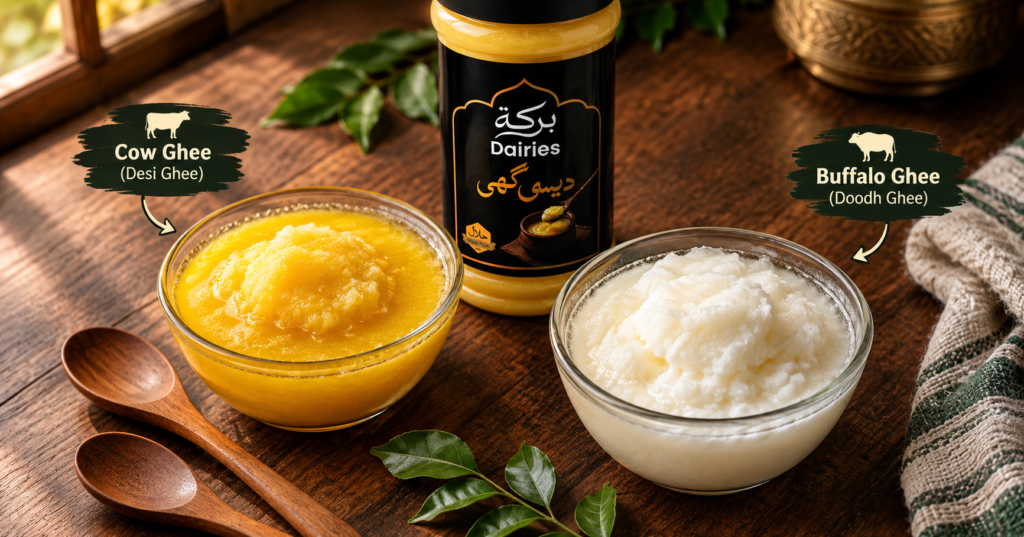
Put a jar of golden ghee beside a jar of white, firm ghee, and the biggest difference between Cow ghee vs buffalo ghee is obvious. The rest is less obvious, and plenty of online advice gets it wrong.
Cow ghee comes from cow’s milk and is golden-yellow, softer and milder in aroma. Buffalo ghee comes from buffalo milk and is whiter, firmer and heavier in flavour. Both are almost pure fat, so neither is a light option. The better choice depends on what you cook, your taste, and any dietary advice you have received.
What Is the Main Difference Between Cow Ghee and Buffalo Ghee?
It starts with the milk. Buffalo milk carries roughly 6 to 8 percent fat, while cow milk sits nearer 3 to 5 percent. That richer cream gives buffalo ghee its dense, firm set, whereas cow ghee is usually softer and a little grainy.
In Pakistan, buffaloes supply roughly 60 to 70 percent of the country’s milk, so white ghee is the everyday default in many homes.
Why Is Cow Ghee Yellow and Buffalo Ghee White?
Cows pass part of the beta-carotene from green fodder into their milk fat, and that pigment tints the ghee gold. Buffaloes convert almost all of it into colourless vitamin A before it reaches the milk, so their ghee stays white or cream.
Cow ghee’s shade also shifts with season and feed, deeper after fresh green fodder and paler in dry months. Colour reflects the animal and its diet, not how pure the ghee is.
Fat, Calories and Cholesterol: Where Comparisons Go Wrong
Many articles say buffalo ghee is far higher in fat and calories per spoon. That is misleading. The extra fat is in the milk, but finished ghee is already about 99 percent fat in either case, so a teaspoon of each carries very similar calories.
Saturated fat and cholesterol figures are also inconsistent. One dairy-technology study reported cow ghee as slightly more saturated (about 73 percent against 68 percent), which is the opposite of what many websites claim. Reported cholesterol levels differ only slightly. In short:
- Both ghees are rich in saturated fat.
- Portion size matters far more than the animal.
- If you have heart disease, high cholesterol, or are pregnant, ask your doctor how much ghee suits you.
Is Cow Ghee Really Easier to Digest?
You will read this everywhere. The claim mostly comes from Ayurvedic tradition and marketing, and we found no direct human studies comparing the two. Treat it as traditional belief, not proven fact. Some people simply prefer cow ghee’s milder aroma.
Which Ghee Suits Which Dish: Cow ghee vs buffalo ghee?
Cow ghee
paratha, daal tadka, khichdi, or a spoonful over hot rice. The mild aroma lets the food come through.
Buffalo ghee
halwa, karah, sooji, and rich salans. A bolder aroma stands up to sugar and heavy spices.
Ghee has a high smoke point, well above typical frying temperatures, so either works for tadka and shallow frying.
Do Not Judge Ghee by Colour Alone
Because colour is the visible difference, many buyers assume yellow means pure. It does not. Colour can be added, and genuine buffalo ghee is naturally pale. Look instead at the seller’s transparency, how the ghee is made, and whether the aroma is natural rather than sharp or artificial.
Which is better for daily use?
Neither is universally better. Choose the taste you prefer and keep portions moderate. Cow ghee suits mild everyday meals, while buffalo ghee suits richer dishes.
Does buffalo ghee have more calories per spoon?
Only marginally, if at all. Both are nearly pure fat, so the calorie gap per teaspoon is small compared with how much you actually use.
Choosing the Right Ghee for Your Family
Cow ghee and buffalo ghee differ mainly in colour, texture and flavour, not in some dramatic health gap. Pick the one that suits your cooking, and check purity. Barakah Dairies makes its desi ghee from cow’s milk using the traditional bilona method; you can view the current jar sizes on our shop page.