
A grainy or daanedaar texture in desi ghee is usually a normal result of natural milk fat crystallising as the ghee cools. It is not, by itself, a sign that the ghee has gone bad—and it is not a laboratory proof that a jar is pure either.
In a Pakistani kitchen, this can be most noticeable in cooler weather: a once-liquid jar firms up, looks slightly uneven, and breaks into tiny crystals when scooped. Understanding why helps you judge the jar more sensibly than relying on one “home test.”
What makes desi ghee grainy?
Ghee is not a single, uniform fat. It is a mixture of milk-fat components, including triglycerides, that melt and solidify at different temperatures. As warm ghee cools, the higher-melting parts begin forming crystals. Those crystals create the familiar granular texture. Dairy-science research links ghee granulation to crystallisation, fatty-acid composition, preparation conditions and cooling behaviour.
This is why two jars of genuine ghee may not look identical. Cow and buffalo milk fats can crystallise differently, and the same ghee can look smoother after a warm spell and more grainy after it has sat in a cool pantry.
Why cooling and storage change the texture
The rate and conditions of cooling matter. When ghee cools gradually, crystals have more opportunity to grow and become visible; faster cooling tends to produce a finer, smoother-feeling structure. Repeated warm-to-cool cycles can also change the way a jar sets. That is a texture change, not automatically a quality failure.
If the granules are bothersome for spreading, place the closed jar in gently warm water until the ghee melts, then allow it to cool undisturbed. Do not introduce water into the jar, and avoid repeated heating just to make it look smooth.
Does grainy ghee mean it is pure?
Graininess can be consistent with natural milk-fat crystallisation, but it cannot confirm purity on its own. A ghee’s texture is influenced by several variables: the milk-fat profile, how it was made, cooling rate, storage temperature and any ingredients present. Adulteration testing requires an appropriate laboratory method, not a visual inspection.
Use texture as one observation, not a verdict. A trustworthy purchase decision also considers the ingredient declaration, sealed packaging, batch and date details, the seller’s traceability, and whether the product behaves and smells as expected when heated.
Grainy versus spoiled: what to look for
A grainy texture alone is usually harmless. Spoilage is more likely to show up as a clearly unpleasant rancid, paint-like or stale smell, an unusually harsh or bitter taste, visible mould, or contamination from moisture or a dirty spoon. In those cases, do not try to rescue the ghee by reheating it. Discard it.
For everyday storage, keep the lid tightly closed, use a clean dry spoon, and keep the jar away from direct sunlight and heat. Follow the label’s storage instructions first.
A practical choice for the family kitchen
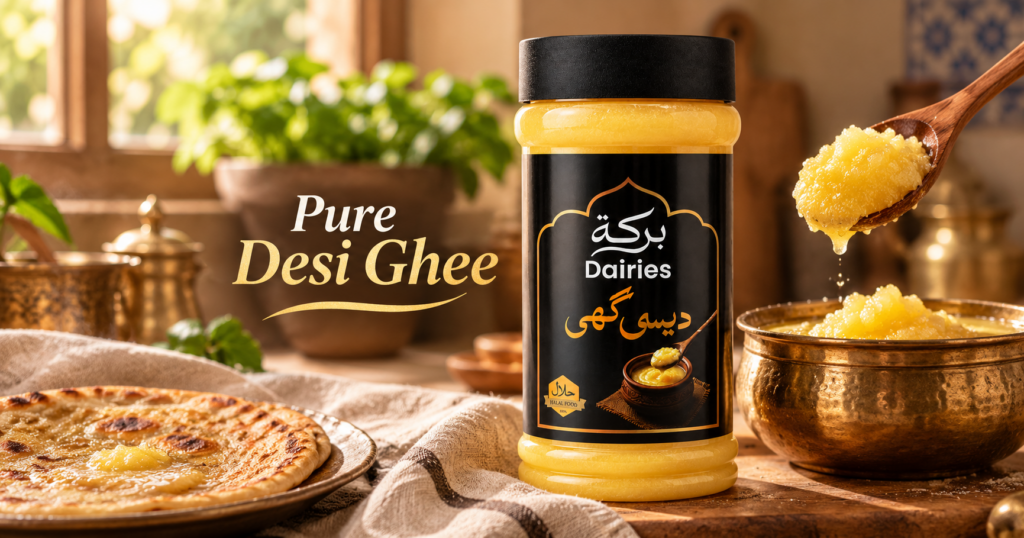
The useful takeaway is simple: daanedaar desi ghee is often the ordinary result of cooling natural milk fat. Look beyond appearance when assessing a product. Barakah Dairies describes its Pure Desi Ghee as premium bilona ghee made from desi cow milk; shoppers can review the product page and its stated details before choosing the size that suits their household.
FAQs
Is grainy desi ghee safe to eat?
Usually, yes—if it smells and tastes normal, has been stored properly, and shows no mould or contamination. Graininess commonly reflects fat crystals formed during cooling. When in doubt because of an off smell, bitter taste, or visible mould, do not consume it.
Why is my ghee smooth in summer but grainy in winter?
Temperature changes how the milk-fat mixture sets. In warmer conditions, more of the fat remains liquid or soft. As the kitchen becomes cooler, higher-melting fat components crystallise, which can make the ghee firmer and more visibly granular.
Can I use a grainy texture as a purity test?
No. It is a useful observation but not a conclusive purity test. Crystal formation depends on composition and handling conditions. If purity needs to be verified for a serious concern, laboratory analysis is the reliable route.