
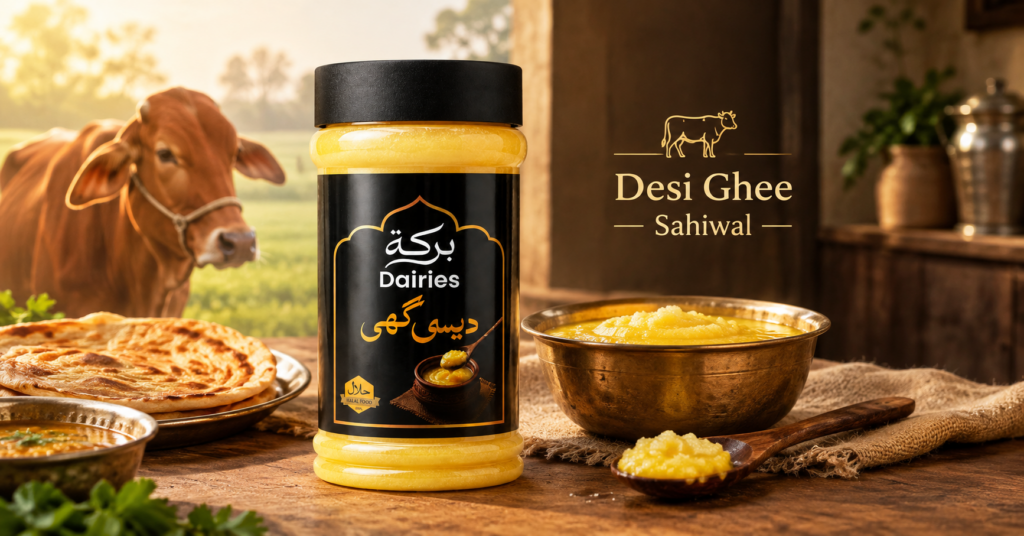
Choose Barakah Dairies if you want desi ghee from a named producer in Sahiwal, made from cow’s milk by a traditional curd-and-churn method in small batches, with no added colour, flavour or preservatives. That is the brand’s own description. The rest of this guide explains what it means and how to judge any ghee before you buy.
What does “Sahiwal” mean on a ghee jar?
Sahiwal is a city and district in Punjab, Pakistan. It is also the name of a cattle breed: the Sahiwal is a zebu breed native to the subcontinent, named after the district. So “Sahiwal ghee” can mean two different things: ghee made in Sahiwal, or ghee from Sahiwal-breed cows.
Barakah Dairies makes the first claim. It says its ghee is made in Sahiwal from cow’s milk sourced from farms there. It does not describe its ghee as breed-specific or A2, and we won’t either.
Why does origin matter for ghee in Pakistan?
Because trust is the real problem, in August 2026, a PCSIR report presented to the National Price Monitoring Committee found that 48% of vegetable ghee samples failed prescribed standards, with trans fat reaching 15.87 g per 100 g against a PSQCA limit of 2 g. That survey covered vegetable ghee, not desi ghee, but it explains why families ask who made their ghee and how. Our desi ghee vs banaspati comparison covers the difference.
A named producer in a known dairy district gives you someone to ask. Origin alone doesn’t prove purity, and only laboratory testing does, but it is a better starting point than an unlabelled tin.
How Barakah Dairies makes its ghee
According to the About Barakah Dairies page, fresh milk is set into curd, churned to separate the butter, then cooked slowly on low heat until golden ghee separates naturally. Batches are small, and the team checks temperature, colour and aroma along the way. No preservatives, artificial colours or flavourings are added.
Well-made ghee should smell like cooked butter, warm and nutty, never perfumed.
What to check before buying any desi ghee
- Ask which milk it comes from: cow, buffalo or a blend. Both are real ghee, but they differ in colour and richness.
- Look for a named maker and location, not just a brand name.
- Read the ingredients. It should say milk fat or butter only.
- Smell it. A strong, sweet, artificial fragrance is a warning sign.
- Be wary of prices far below the going rate. Real ghee needs a lot of milk.
- Treat home tests as clues, not lab results. Our guide on how to identify pure desi ghee explains what they can and cannot show.
How much should you use?
Even excellent ghee is almost pure fat, around 99.5%, and more than half of it is saturated. WHO advises keeping saturated fat under 10% of daily energy and trans fat under 1%. So use it the traditional way: a spoon on daal, roti or paratha, not extra portions on top of everything. If you have high cholesterol or heart disease, ask your doctor how much suits you.
FAQs
Is Sahiwal desi ghee the same as A2 ghee?
Not necessarily. Sahiwal describes a place and a breed, while A2 describes a milk protein variant. Ghee contains very little protein, and a 2009 EFSA review found no established cause-effect link between A1 milk peptides and chronic disease. Barakah Dairies does not market its ghee as A2.
Is Barakah Dairies ghee made from cow or buffalo milk?
Cow. The brand states that its ghee is made from 100% cow’s milk, with no blended oils.
How should I store it?
Keep the jar tightly sealed in a cool, dry place. Refrigeration is not needed, according to the brand. Ghee naturally softens in summer and firms up in winter.